Island Peak Climbing difficulty
- Alpine grade: Graded PD (Physically Difficult/Peu Difficile) on the international alpine scale. Island Peak includes crevasse crossings, glacier travel, and fixed-rope ascents.
- NMA (Nepal Mountaineering Association): Categorized as a Group B trekking peak.
- Climbers' stance: An ambitious 6,000-meter peak for beginner climbers. Technical difficulty depends heavily on conditions and is harder when mixed rock is exposed.
Island Peak Climbing is not as extremely challenging as 7,000-meter or 8,000-meter mountains. However, it is also not as easy as trekking. Island Peak Climbing tests your fitness, climbing skills, altitude tolerance, and mental endurance.
You will be exposed to harsh cold and wind. The trekking part is all good and achievable, but the main challenge begins when you start climbing from Island Peak Base Camp.
Those two days of climbing from the base camp to the summit and returning are going to be the toughest part of this journey. You will climb a seriously steep wall of ice using fixed ropes and at night.
Note that strong legs are not enough for the Island Peak climb. You need climbing knowledge and skills. Similarly, you should also be fine with the cold and stay sharp under extreme alpine conditions.
We go slow and steady from Lukla to Island Peak Base Camp. Our Island Peak Climbing itinerary includes a hike to Everest Base Camp and Kala Patthar, which is great for acclimatization. In addition, we also take two acclimatization days at Namche Bazaar and Dingboche village.
This way, you will be well acclimatized ahead of climbing and adjust to the cold, high-altitude environment. Once you leave the Island Peak Base Camp, you will climb on glaciers and come across the vertical wall.
Climbing the vertical wall (40°-60° of snow and ice) is the final challenge on Island Peak. You will use fixed ropes, a jumar (or ascender), harness, and a safety line. Towards the summit, the ridge becomes narrow. This is where you have to be very cautious.
Altitude challenge on Island Peak
You will ascend above 6,000 meters on the Island Peak climb, and it is one of the biggest challenges of this adventure. Once you go above 5,000 meters, your body experiences low oxygen levels, and it continues to deplete as you ascend higher.
Even a small movement can feel heavier, and your body will not be at its optimal performance. Regardless of that, you have to keep moving. This is why you should climb slowly while properly acclimating.
Note that even the fittest individuals are in shock when they see themselves getting exhausted quickly. What matters here is your previous high-altitude experiences.
If you actively trek or travel above 5,000 meters, then adjusting to high altitude will not be a challenge for you. However, if that's not the case, our Island Peak Climbing itinerary is designed to provide ample acclimatization opportunities to climbers and increase summit chances.
Acclimatization tips:
- Do not skip acclimatization hikes.
- Follow our acclimatization plans and rest at strategic points as per your guide's instructions.
- Ascend slowly and maintain a steady pace.
- Moving too fast is risky, and you are only asking for trouble. Take it easy and slow.
- Have carbohydrate-rich meals, especially lunch.
- Drink lots of water daily and have plenty of soups. Ginger hot teas are great for acclimatization.
- Avoid alcoholic drinks, limit caffeine intake, and do not smoke. In short, stay away from anything that will dehydrate you. It increases the risk of altitude sickness.
- Get ample sleep. Your body needs to recover before the next hike.
- Listen to your body and address any discomfort on time.
The summit day
The summit day on the Island Peak starts between midnight and 2:00 AM. You will have a warm cup of soup or tea and food before leaving your camp. Following the lead of your team leader, begin climbing in the dark and in silence.
This is the time when the weather is very stable, and there are no strong winds. It can be intimidating, but enjoy the peace and the climb. Focus on your steps and have faith in your guide. You will be fine.
You will spend a short time on Island Peak summit and return following the same route to the Island Peak Base Camp. From base camp to base camp, the round trip will be around 10-14 hours long.
Best time to climb Island Peak
The best time to climb Island Peak is spring (March to May) and autumn (September to November). These are peak climbing seasons.
Some climbers also choose winter (December to February) for Island Peak Climbing. However, climbing Island Peak in winter is extremely challenging and has high objective risks such as snowstorms and whiteouts.
Spring is a bit warmer than autumn but has more snow than in autumn. Autumn is colder and has firmer snow. You will enjoy Island Peak Climbing in both of these seasons.
If you want to see foothills covered in rhododendrons, climb Island Peak in spring. Rhododendrons bloom all over the lower elevations. In autumn, you can also see major Nepalese festivals like Dashain and Tihar up close.
Landscapes and mountain vistas are excellent in both seasons. Likewise, visibility is great. Overall, temperatures remain moderate at low and mid elevations but get colder as you ascend higher.
The summit window:
Weather in the Himalayas is notorious. It can change quickly without giving any warning. So, even in the peak seasons, we stay alert and actively monitor the weather as we climb.
A summit window is when the weather is calmest. On a 6,000-meter peak, it is not that tough to get a summit window. Still, you need to be patient.
Travel insurance for Island Peak Climbing
Regardless of your previous expertise, fitness, knowledge, and team, you need well-covered travel insurance for Island Peak Climbing. You never know when or how things might go wrong in the Himalayas.
Even with strong preparation, there are risks, such as bad weather, avalanches, and natural disasters that are beyond our control.
To be safe in times like these, you need good insurance that covers immediate search and rescue, helicopter evacuation up to 6,000 meters, trip cancellation, medical treatment, etc.
You can buy travel insurance online. Make sure your insurance company specializes in extreme mountain adventures and covers climbing in Nepal.
Travel insurance with the coverages that we have mentioned above is a must for joining Island Peak Climbing with us. Climbers have to submit a copy of their travel insurance before leaving Kathmandu.
Island Peak Climbing permit
Our Island Peak Climbing package includes all permits, including the climbing royalty, garbage deposit, Sagarmatha National Park permit, and the Khumbu Pasang Lhamu Rural Municipality permit.
The permit fees are -
- Island Peak climbing permit fee: USD 250 per person in spring (March to May) and autumn (September to November) and USD 125 per person in summer and winter season
- Sagarmatha National Park permit fee: USD 30 per person
- Khumbu Pasang Lhamu Rural Municipality permit fee: USD 20 per person
Note that our Island Peak Climbing package does not include the Nepal travel visa fee.
Accommodation during Island Peak Climbing
In Kathmandu, you will stay in a three-star hotel in the busy tourist hub, Thamel. During trekking, you will get twin-shared standard rooms. For premium service or a single room, you have to pay extra. At Island Peak Base Camp, you will stay in tents.
The villages on the way to Island Peak Base Camp have both affordable and premium lodges. Our Island Peak Climbing package includes a standard affordable lodge. Rooms are simple and cozy.
Sleeping tents are recommended for additional comfort and warmth. Toilets are shared between the trekkers. In some lodges, you may get private bathrooms, but standard lodges usually have common bathrooms.
At the base camp, our support team will take care of establishing the tents, cooking meals, and other chores. We provide separate sleeping tents with comfortable mattresses and solar-powered lights to our climbers.
Food and drinking water
In Kathmandu, you will get breakfast included in our package cost. You have to buy lunch and dinner on your own. As there are plenty of food choices, we let climbers choose what and where they want to eat.
In the mountains, we provide three meals a day - breakfast, lunch, and dinner. During trekking, you will have meals in the lodges. The food options are great, especially in villages like Lukla and Namche Bazaar.
You will have noodles, rice, momo, soup, porridge, pasta, eggs, etc. Some popular meals among trekkers are fried rice, dal bhat, thukpa, pasta, Sherpa stew, porridge, garlic soup, and pancakes.
In Lukla and Namche Bazaar, you will also find an excellent variety of firewood pizza, burgers, meat dishes, bakery items, macaroni, French fries, etc.
At the Island Peak Base Camp, we prepare and cook our meals. Our cooks will take care of the kitchen and make sure you are well fed. You will have nutritious, dense meals that are easy to digest and provide high energy.
Similarly, clean drinking water is available throughout the journey. You can pack a water purification tablet for backup.
We request our climbers to inform us about any allergies ahead of time and be cautious about what they eat throughout the journey.
Additional expenses during the Island Peak Climbing
Apart from the Island Peak Climbing package cost, you have to prepare for several other miscellaneous expenses such as travel insurance, international flight tickets to/from Kathmandu, trekking and climbing gear, food in Kathmandu, trips for guide and porter (mandatory), shopping, personal expenses during trekking (WiFi, hot shower, charging, etc.), extra food, and bar bills.
To charge your phone, you have to pay roughly USD 2; USD 5 for WiFi; and USD 3-5 for a hot shower. Note that the price may be higher at higher elevations. These are your personal expenses and are not covered in our package cost.
Tipping your guide and porter is also a crucial part of climbing in Nepal. Our Island Peak Climbing package does not include tips. You can tip as per your wish and your team's hard work.
ATM on the route
If you need extra money or want to withdraw money after leaving Kathmandu, get it in Lukla or Namche Bazaar. After Namche Bazaar, you may not get a chance to withdraw money elsewhere.
Communication
WiFi is available in lodges in villages at low altitude, but they are not that reliable, especially if the weather is not stable. The higher you ascend, the poorer the network gets. The same goes for the mobile network.
During climbing, we use walkie-talkies to communicate within the team. For emergency communication, we use a satellite phone.
Island Peak Climbing last-minute booking
The last-minute booking confirmation is subject to the availability of Sherpas, Lukla flights, and other resources. Your fitness also determines whether you can climb Island Peak at the last minute or not.
To book the Island Peak climb at the last minute, feel free to contact us via WhatsApp or email. If you are in Kathmandu, you can also visit our office.
How dangerous is Island Peak?
Climbing a mountain in the Himalayas is never risk-free. However, there haven't been many casualties on Island Peak in recent years. Compared to 7,000-meter and 8,000-meter mountains, Island Peak has far fewer objective hazards. If you are well prepared and climb with a strong team, you do not need to worry about anything.
Island Peak Climbing safety
Our climbers' safety is the top priority during Island Peak Climbing. We assist you during preparation and planning, guide you in physical preparation, plan acclimatization to suit your body, and ensure all logistics are carefully handled.
We make sure you gain acclimatization in a controlled way. Our itinerary has two rest days and also a hike to EBC and Kala Patthar before climbing starts. It lowers the risk of altitude sickness while you push towards the summit of Island Peak.
Similarly, our Sherpas will monitor your health and ensure you have ample food and water daily. We also prioritize our recovery time. Recovery is a significant aspect of Island Peak Climbing. It makes sure you are ready for the summit.
You will climb with professional Sherpa climbers who have summited Island Peak several times before. They will teach you the basics of peak climbing and make you mountain-smart.
On the other hand, our support crew takes care of chores and ensures you are well fed. With us, you can climb Island Peak without any hassle. We secure the climbing route with ropes and also teach you how to climb using the ropes.
Pre-climbing training
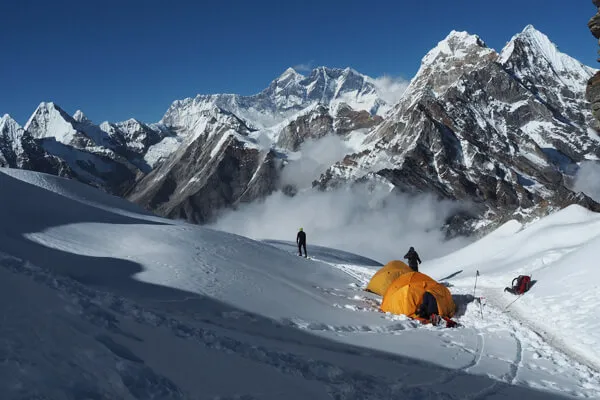
At the Island Peak Base Camp, there will be a small pre-climbing training. Your team leader will organize the training to teach you the basics of climbing.
You will learn to walk using crampons, an ascender, a descender, and a harness. Similarly, you will learn self-arrest and how to protect yourself from frostbite. This pre-climbing training will be a big boost of confidence for you.
Lukla flights
Lukla flights are highly weather-dependent and can be delayed if the weather suddenly changes. We recommend you have 1-2 days extra in hand just in case you come across any weather or other unforeseen delays.
Some climbers switch to helicopter flight in case bad weather disrupts their standard Lukla flight. As helicopters fly below cloud level, small weather changes do not affect them.
However, to upgrade to helicopter flight from Kathmandu to Lukla or Lukla to Kathmandu, you need to pay USD 650 to USD 750. It is a great option that allows you to stay on your scheduled itinerary.
The standard flight ticket cost will be refunded when processed by the airline. It takes a couple of business days.
Nepal travel visa
Climbers have to get the Nepal travel visa on their own. It is easy to obtain a Nepal travel visa, and travelers from many countries can get an on-arrival travel visa upon landing at Kathmandu Airport or while entering the country through any border point.
Alternatively, you can visit the Nepalese Embassy or Consulate Office to get the Nepal travel visa. Make sure your visa covers the expedition duration.
On-arrival travel visa:
You can get the on-arrival Nepal tourist visa at all international airports and border entry points. For a quick process, apply for the on-arrival visa at least 15 days before your arrival day in Kathmandu. Or, you can complete the visa form and pay the fee upon arriving at the airport.
Nepal tourist visa fees 2026:
- 15 days: USD 30
- 30 days: USD 50
- 90 days: USD 25
Our Island Peak Climbing package does not cover travel visa fees.
Documents required for a tourist visa:
- Valid passport (minimum 6 months validity)
- Completed visa form
- Visa fee (cash/card)
- Passport-size photo (rarely required now—often taken digitally)
Island Peak Climbing emergency and evacuation
During an emergency, we assess the situation and provide helicopter evacuation if needed. Nepal has incredible helicopter evacuation infrastructure for climbers. You can get assistance in under half an hour of request.
For helicopter evacuation, it is important to have travel insurance that covers the expenses incurred. If you get hurt or sick on the way to the summit, our team will bring you down to the base camp.
The helicopter arrives at the base camp and airlifts you to the hospital in Kathmandu. As climbing comes with unpredictable circumstances and risks, it is best to carry comprehensive travel insurance as a backup.
Similarly, in case of altitude sickness, we assess your condition first. If it is AMS (Acute Mountain Sickness), we provide first aid and descend (if needed). If it is the case of HAPE or HACE, we immediately arrange helicopter evacuation and medical treatment.